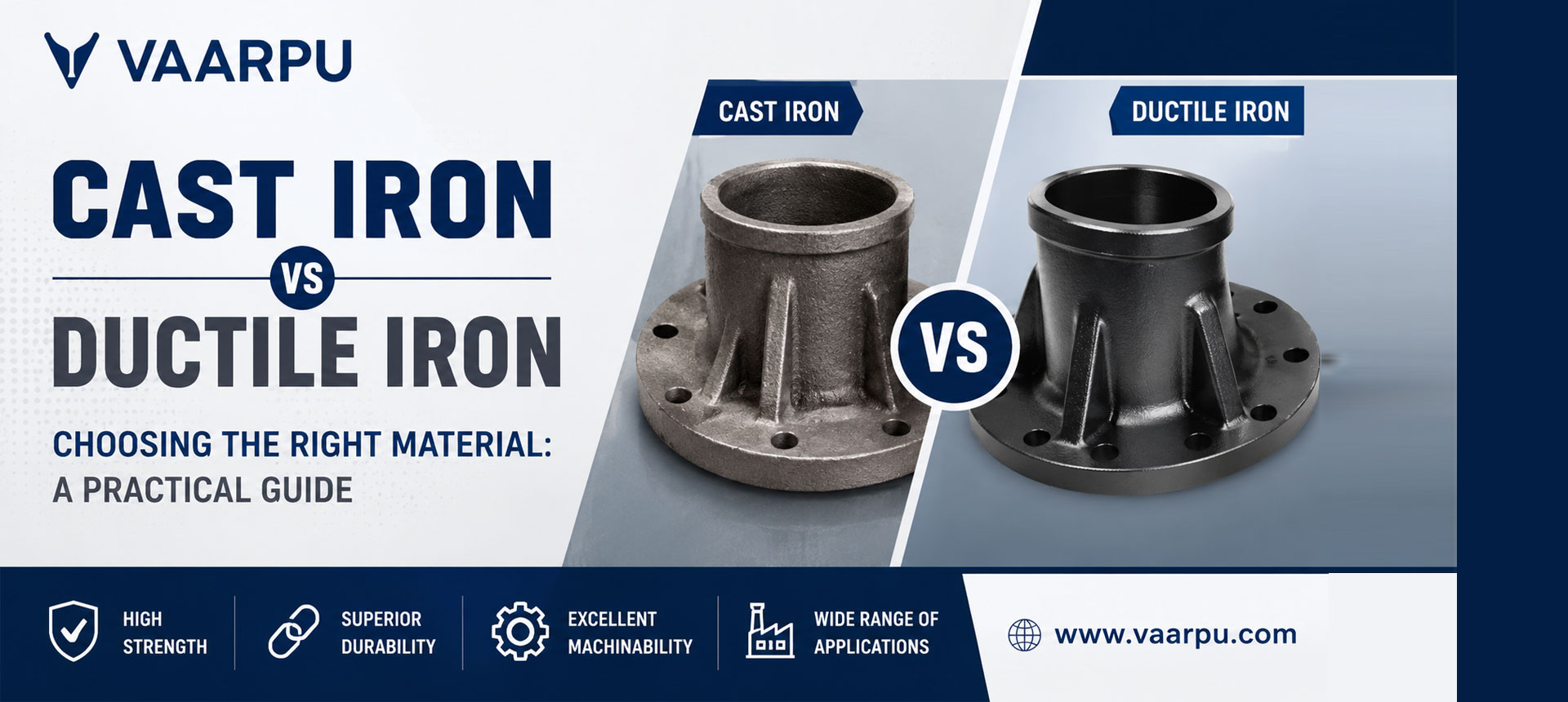
Cast Iron vs Ductile Iron
Cast iron and ductile iron are two of the most widely used ferrous metals in manufacturing. While they may look similar, they differ significantly in terms of strength, flexibility, impact resistance, and applications. Understanding these differences helps engineers, buyers, and manufacturers choose the right material for their project.
Cast Iron
Cast iron is an iron-carbon alloy containing approximately 2%–4% carbon along with silicon and small amounts of other elements. The carbon exists primarily as graphite flakes, giving cast iron excellent vibration damping and machinability but making it relatively brittle.
Key Characteristics of Cast Iron
- Excellent compressive strength
- High wear resistance
- Good thermal conductivity
- Outstanding vibration damping
- Easy to machine
- Lower manufacturing cost
- Brittle under impact or tensile loads
Read more like this Types of Cast Iron: Complete Guide to Properties, Grades, Applications & Differences
What Is Ductile Iron?
Ductile iron, also known as nodular iron or spheroidal graphite iron (SG iron), is produced by adding small amounts of magnesium or cerium to molten iron. This changes the graphite from flakes into spherical nodules, dramatically improving strength and ductility.
Key Characteristics of Ductile Iron
- High tensile strength
- Excellent impact resistance
- Good fatigue strength
- Superior ductility
- Better pressure resistance
- Good machinability
- Longer service life in demanding applications
Cast Iron vs Ductile Iron Comparison
| Property | Cast Iron | Ductile Iron |
| Graphite Shape | Flakes | Spherical nodules |
| Tensile Strength | Low to moderate | High |
| Ductility | Very low | High |
| Brittleness | High | Low |
| Impact Resistance | Poor | Excellent |
| Fatigue Resistance | Moderate | Excellent |
| Machinability | Excellent | Very good |
| Wear Resistance | Excellent | Excellent |
| Pressure Resistance | Moderate | High |
| Cost | Lower | Slightly higher |
Mechanical Properties Comparison
| Property | Cast Iron | Ductile Iron |
| Tensile Strength | 150–400 MPa | 400–900 MPa |
| Yield Strength | Very low | 250–600 MPa |
| Elongation | 0–2% | 2–18% |
| Hardness | 150–300 HB | 130–300 HB |
| Density | Similar | Similar |
Read more like this Advantages of Cast Iron: Why It Remains the Preferred Material for Modern Engineering
Advantages of Cast Iron
- Lower production costs
- Excellent vibration absorption
- Superior wear resistance
- Easy casting into complex shapes
- Good machinability
- Suitable for high-temperature applications
Common Applications
- Engine blocks
- Machine tool bases
- Brake discs
- Cookware
- Pump housings
- Industrial machinery
Advantages of Ductile Iron
- High mechanical strength
- Excellent toughness
- Superior impact resistance
- Better fatigue performance
- Handles high internal pressure
- Longer service life
Common Applications
- Water and sewer pipes
- Automotive suspension components
- Crankshafts
- Wind turbine hubs
- Valve bodies
- Heavy equipment parts
- Agricultural machinery
Which Material Is Better?
The best choice depends on your application’s requirements.
Choose cast iron when you need:
- Cost-effective components
- Excellent vibration damping
- High wear resistance
- Complex castings
- Static load applications
Choose ductile iron when you need:
- High strength
- Impact resistance
- Pressure-bearing capability
- Dynamic loading performance
- Long-term durability
Industries That Use These Materials
- Automotive
- Construction
- Agriculture
- Mining
- Oil & Gas
- Water Infrastructure
- Power Generation
- Heavy Engineering
Manufacturing Differences
The primary distinction lies in the graphite structure formed during solidification.
- Cast Iron: Graphite forms as flakes, creating stress concentration points that increase brittleness.
- Ductile Iron: Magnesium treatment causes graphite to form as rounded nodules, significantly improving strength, ductility, and fatigue resistance.
Cost Comparison
Cast iron is generally 10–30% less expensive than ductile iron due to its simpler production process. However, ductile iron often provides better long-term value because of its greater durability, reduced maintenance, and longer service life in demanding environments.
Read more like this How to Choose the Right Casting Supplier in India: Complete Buyer’s Guide
Cast Iron vs Ductile Iron: Industry Standards
Both materials are manufactured according to internationally recognized standards to ensure consistent quality and performance.
Common Cast Iron Standards
- ASTM A48 – Gray Iron Castings
- ASTM A159 – Automotive Gray Iron Castings
- EN 1561 – Grey Cast Iron
- ISO 185 – Grey Cast Irons
Common Ductile Iron Standards
- ASTM A536 – Ductile Iron Castings
- ASTM A395 – Ferritic Ductile Iron
- EN 1563 – Spheroidal Graphite Cast Iron
- ISO 1083 – Spheroidal Graphite Cast Irons
When sourcing castings, buyers should ensure the supplier can manufacture to the required international standard and provide material test certificates.
Heat Treatment Differences
Heat treatment can significantly improve the mechanical properties of both materials.
Cast Iron Heat Treatments
- Stress relieving
- Annealing
- Normalizing
- Surface hardening
These processes improve machinability, reduce internal stresses, and increase wear resistance.
Ductile Iron Heat Treatments
- Ferritizing
- Normalizing
- Austempering (ADI)
- Tempering
Austempered Ductile Iron (ADI) offers exceptional strength, wear resistance, and fatigue performance, making it suitable for replacing forged steel in some applications.
Corrosion Resistance
Neither cast iron nor ductile iron is naturally corrosion-proof. However, their performance can be enhanced through protective coatings and surface treatments.
Cast Iron
- Performs well in dry environments
- Can rust when exposed to moisture
- Often protected with paint or powder coating
Ductile Iron
- Better suited for underground and water applications
- Commonly coated with:
- Zinc coating
- Epoxy coating
- Cement mortar lining
- Bituminous coating
These protective systems significantly extend the lifespan of ductile iron pipelines and infrastructure components.
Sustainability and Recyclability
Both cast iron and ductile iron are among the most sustainable engineering materials.
Environmental Benefits
- 100% recyclable
- High recycled metal content
- Long service life
- Reduced material waste
- Lower lifecycle costs
Many foundries use recycled steel scrap and return foundry scrap to produce new castings, supporting circular manufacturing practices.
Quality Inspection for Castings
Reputable foundries perform multiple quality checks before shipping castings.
Typical inspections include:
- Chemical composition analysis
- Tensile strength testing
- Hardness testing
- Dimensional inspection
- Ultrasonic testing (UT)
- Magnetic particle inspection (MPI)
- Radiographic testing (X-ray)
- Visual inspection
- Pressure testing (for valves and pipes)
These inspections ensure the castings meet customer specifications and international standards.
Read more like this Why India is becoming a Global Hub for Casting Manufacturing
Choosing the Right Material: A Practical Guide
Selecting between cast iron and ductile iron depends on the operating environment and performance requirements.
| Application Requirement | Recommended Material |
| Low-cost machinery | Cast Iron |
| Heavy impact loads | Ductile Iron |
| Water transmission pipelines | Ductile Iron |
| Machine beds | Cast Iron |
| Engine blocks | Cast Iron |
| Automotive suspension | Ductile Iron |
| Agricultural machinery | Ductile Iron |
| Industrial pumps | Either, depending on operating pressure |
| High vibration equipment | Cast Iron |
| Pressure vessels | Ductile Iron |
Why Buyers Prefer Ductile Iron for Modern Engineering
Over the past few decades, ductile iron has become the preferred material for many structural and heavy-duty applications because it offers an excellent balance of strength, toughness, and cost.
Key advantages include:
- Comparable strength to cast steel at a lower cost
- Reduced component weight through optimized designs
- Excellent fatigue resistance
- Longer service life
- Lower maintenance requirements
- Better performance under dynamic loading
These benefits make ductile iron an ideal choice for industries such as automotive, mining, construction, transportation, and water infrastructure.
Common Myths about Cast Iron and Ductile Iron
Myth 1: They are the same material.
Reality: While both are iron-carbon alloys, the graphite structure is different, resulting in distinct mechanical properties.
Myth 2: Ductile iron cannot rust.
Reality: Ductile iron can corrode if left unprotected. Proper coatings or linings are necessary for corrosive environments.
Myth 3: Cast iron is always weaker.
Reality: Cast iron offers excellent compressive strength and wear resistance, making it ideal for many stationary and high-wear applications.
Myth 4: Ductile iron is too expensive.
Reality: Although the initial material cost is higher, ductile iron often provides lower lifecycle costs through improved durability and reduced maintenance.
Final Thoughts
Both cast iron and ductile iron play essential roles in modern manufacturing. Cast iron remains an economical choice for components requiring excellent wear resistance and vibration damping, while ductile iron delivers superior strength, toughness, and reliability for demanding structural and pressure applications.
For buyers selecting cast components, evaluating factors such as mechanical properties, service conditions, production volume, and quality standards is essential to choosing the most suitable material.
For manufacturers, OEMs, and industrial buyers, partnering with an experienced foundry ensures consistent quality, compliance with international standards, and reliable delivery.
Partner with Vaarpu Industries
Whether you need gray cast iron, ductile iron, or custom-engineered castings, Vaarpu Industries delivers precision-manufactured components for industries including automotive, agriculture, construction, mining, pumps, valves, and heavy engineering.
Our capabilities include:
- Custom cast iron and ductile iron castings
- Precision machining and finishing
- Pattern development
- Quality testing and inspection
- On-time global delivery
- Competitive pricing for bulk and OEM orders
Get in touch with Vaarpu Industries today to discuss your project requirements and discover how our expertise in iron casting can support your manufacturing needs.
Frequently Asked Questions on Cast Iron vs Ductile Iron
Is ductile iron stronger than cast iron?
Yes. Ductile iron offers significantly higher tensile strength, impact resistance, and fatigue performance than conventional cast iron.
Why is cast iron more brittle?
The graphite flakes in cast iron create stress concentration points, making it more susceptible to cracking under tensile or impact loads.
Can ductile iron replace cast iron?
In many structural and pressure-bearing applications, yes. However, cast iron remains the preferred choice where vibration damping, wear resistance, and lower cost are the primary considerations.
Which is easier to machine?
Gray cast iron generally offers the best machinability due to its graphite flake structure, though ductile iron also machines well with appropriate tooling.