Advantages of Cast Iron
What Is Cast Iron?
Cast iron is an iron-carbon alloy containing 2% to 4% carbon, along with silicon and small amounts of other elements such as manganese, sulfur, and phosphorus. It is produced by melting iron and pouring it into moulds to create complex shapes. Known for its excellent castability, wear resistance, compressive strength, and cost-effectiveness, cast iron is widely used in automotive, construction, machinery, pipes, pumps, valves, and industrial equipment.
Why Cast Iron Is Still Widely Used Today
Every engineering material has strengths and weaknesses, but very few deliver as many practical benefits as cast iron. It combines affordability with dependable mechanical performance, making it suitable for both high-volume production and heavy-duty industrial applications.
One major reason for its continued popularity is its manufacturing flexibility. Molten cast iron fills intricate mould cavities easily, enabling manufacturers to produce complex geometries with minimal machining. This reduces production time, minimizes waste, and lowers overall manufacturing costs. Industry organizations such as the Iron Casting Research Institute also highlight that cast iron provides an excellent strength-to-cost ratio, requires less energy for machining due to free graphite in its microstructure, and often eliminates the need for extensive heat treatment.
Read more like this 5 types of Cast Iron
Top Advantages of Cast Iron
Excellent Castability
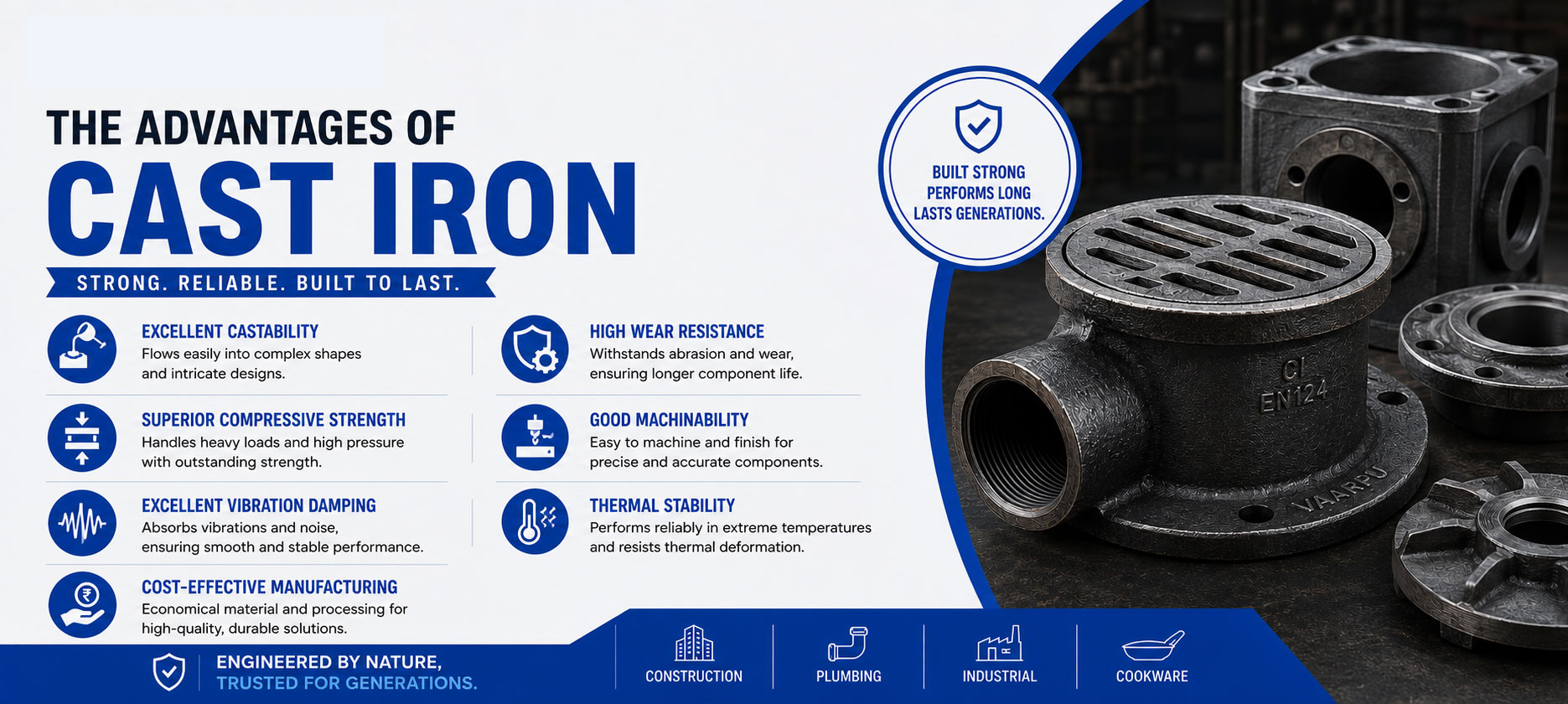
Perhaps the greatest advantage of cast iron is reflected in its name—it is exceptionally easy to cast. Compared with many steels, molten cast iron has higher fluidity, allowing it to completely fill mould cavities before solidifying. This makes it ideal for manufacturing components with intricate internal passages, thin walls, ribs, bosses, and detailed external features.
Excellent castability also reduces defects such as shrinkage and incomplete filling. Manufacturers can produce highly complex parts as a single casting instead of assembling multiple fabricated components. This simplifies production while improving structural integrity and lowering assembly costs. Industries producing pump bodies, valve housings, gearbox casings, machine frames, and compressor components rely heavily on this advantage.
Outstanding Wear Resistance
Cast iron exhibits remarkable resistance to wear and abrasion because of its graphite structure and carbon-rich composition. During operation, graphite acts as a natural lubricant, reducing friction between moving surfaces. This characteristic extends component life while lowering maintenance requirements.
White cast iron offers exceptional hardness for abrasive environments such as mining equipment and crusher liners, while grey cast iron provides an excellent balance between wear resistance and machinability. Brake discs, cylinder liners, rolling mill components, agricultural machinery, and industrial pumps all benefit from this property, making cast iron one of the most durable engineering materials available.
Superior Compressive Strength
Although standard grey cast iron is relatively brittle under tensile loading, it possesses exceptionally high compressive strength. This makes it perfect for components subjected primarily to compressive forces rather than bending or impact loads.
Machine tool beds, structural supports, press frames, foundation blocks, and heavy equipment housings are excellent examples where compressive strength is more important than tensile strength. The material maintains dimensional stability under enormous loads without significant deformation, ensuring long service life and reliable equipment performance. Engineers continue to specify cast iron for such applications because few materials provide similar performance at such competitive manufacturing costs.
Excellent Vibration Damping
One of cast iron’s most valuable—and often underestimated—properties is its ability to absorb vibration. The graphite flakes present in grey cast iron dissipate vibration energy far more effectively than steel.
This damping capability improves machining accuracy, reduces operating noise, extends bearing life, and minimizes fatigue failures in machinery. Precision CNC machines, lathes, milling machines, compressors, pumps, and industrial equipment frequently use cast iron bases because stable foundations directly improve manufacturing precision. In many heavy engineering applications, vibration damping alone justifies selecting cast iron over fabricated steel structures.
High Machinability
Cast iron machines exceptionally well, allowing manufacturers to achieve high cutting speeds while reducing tool wear. The graphite within the microstructure acts as a built-in lubricant during machining, producing smoother cutting action and better surface finishes.
Better machinability translates into lower production costs because machining cycles are shorter and cutting tools last longer. Foundries and machining shops appreciate this characteristic since it increases productivity without sacrificing dimensional accuracy. Industries manufacturing engine blocks, pump casings, valve bodies, bearing housings, and industrial machinery consistently benefit from this manufacturing advantage.
Cost-Effective Manufacturing
From raw material availability to production efficiency, cast iron remains one of the most economical engineering materials.
Several factors contribute to its low overall cost:
| Factor | Cast Iron Advantages |
| Raw Material Cost | Lower than many alloy steels |
| Casting Process | Excellent mould filling reduces waste |
| Machining | Easier machining lowers tooling costs |
| Heat Treatment | Often unnecessary |
| Production Volume | Suitable for both small and mass production |
These economic benefits explain why cast iron continues to dominate industries where reliability and affordability are equally important.
Thermal Conductivity and Heat Retention
Cast iron offers excellent thermal conductivity and outstanding heat retention. These properties make it suitable for both industrial machinery and cookware.
In engineering applications, thermal stability allows components such as engine blocks, brake discs, exhaust manifolds, and cylinder heads to distribute heat evenly while resisting thermal distortion. Stable operating temperatures improve performance and reduce localized stresses.
For cookware, heat retention enables consistent cooking temperatures, minimizing hot spots and delivering uniform cooking performance. This unique combination of thermal conductivity and thermal stability makes cast iron valuable across multiple industries.
Corrosion Resistance in Specific Applications
Although untreated cast iron can rust, properly coated or alloyed cast iron performs remarkably well in corrosive environments. Surface treatments, paints, epoxy coatings, and specialized alloy compositions significantly improve corrosion resistance.
High-silicon and alloyed cast irons are widely used in chemical processing, water treatment, municipal infrastructure, and industrial piping systems because they withstand aggressive operating environments while maintaining structural integrity over long service periods.
Cast Iron vs Steel
| Property | Cast Iron | Steel |
| Castability | Excellent | Moderate |
| Wear Resistance | Excellent | Good |
| Machinability | Excellent | Moderate |
| Vibration Damping | Outstanding | Lower |
| Tensile Strength | Lower | Higher |
| Impact Resistance | Lower | Higher |
| Manufacturing Cost | Lower | Higher |
| Complex Shapes | Easier | More Difficult |
Steel remains the preferred option where high tensile strength and impact resistance are essential. Cast iron excels when manufacturers prioritize wear resistance, dimensional stability, vibration damping, machining efficiency, and economical production. Material selection should always match the operating requirements rather than assuming one material is universally superior.
Choosing the Right Type of Cast Iron
Selecting the appropriate grade of cast iron is just as important as choosing cast iron itself. Different applications demand different combinations of strength, ductility, hardness, machinability, and wear resistance. Understanding these differences helps engineers achieve the best balance between performance, cost, and service life.
| Type of Cast Iron | Key Advantages | Typical Applications |
| Grey Cast Iron | Excellent vibration damping, machinability, thermal conductivity | Engine blocks, machine beds, brake discs, pump housings |
| Ductile (Nodular) Cast Iron | High tensile strength, ductility, impact resistance | Pipes, crankshafts, gears, heavy equipment |
| White Cast Iron | Extremely hard, excellent abrasion resistance | Crusher liners, grinding mills, mining equipment |
| Malleable Cast Iron | Improved toughness and flexibility | Pipe fittings, brackets, agricultural equipment |
| Compacted Graphite Iron (CGI) | Higher strength than grey iron with good thermal performance | High-performance diesel engines, cylinder heads |
Engineers should evaluate several important factors before selecting a cast iron grade:
- Mechanical loading conditions
- Operating temperature
- Exposure to corrosion or chemicals
- Wear and abrasion requirements
- Machining requirements
- Product life expectancy
- Production cost
- Industry standards and specifications
Working closely with an experienced foundry ensures the selected material meets both performance expectations and manufacturing requirements. Proper material selection can significantly improve product reliability while reducing maintenance and replacement costs over the component’s lifecycle.
Read more like this How to Choose the Right Casting Supplier in India: Complete Buyer’s Guide
Why Trust Vaarpu for Cast Iron Components?
When selecting a casting manufacturer, technical expertise is just as important as material quality. At Vaarpu, every casting is engineered to meet demanding industrial applications through a combination of modern foundry practices, stringent quality control, and extensive metallurgical knowledge.
Conclusion
The advantages of cast iron have allowed it to remain one of the most widely used engineering materials despite continuous advancements in manufacturing technology. Its exceptional castability, impressive wear resistance, superior compressive strength, outstanding vibration damping, excellent machinability, and cost-effective production make it an ideal choice for countless industrial applications. From automotive engines and machine tool beds to municipal infrastructure and heavy machinery, cast iron continues to deliver dependable performance where durability and reliability matter most.
Modern foundries have further expanded the capabilities of cast iron through specialized grades such as grey iron, ductile iron, white iron, malleable iron, and compacted graphite iron. Each offers unique properties suited to specific engineering challenges. By understanding these differences and partnering with an experienced manufacturer like Vaarpu, businesses can choose the right material for their application, improve product longevity, reduce maintenance costs, and achieve better overall value. As industries continue to demand stronger, more efficient, and more sustainable solutions, cast iron remains a proven material that combines engineering excellence with economic efficiency.
Read more like this Why India is becoming a Global Hub for Casting Manufacturing
FAQs on Advantages of Cast iron
-
What are the main advantages of cast iron?
Cast iron offers excellent castability, high wear resistance, superior compressive strength, good machinability, excellent vibration damping, thermal stability, and cost-effective manufacturing, making it ideal for many industrial applications.
-
Why is cast iron preferred over steel in some applications?
Cast iron is often preferred because it is easier to cast into complex shapes, provides better vibration damping, offers superior wear resistance, and is generally more economical to manufacture than steel.
-
Which type of cast iron is the strongest?
Ductile cast iron is generally the strongest type due to its high tensile strength, improved ductility, and excellent impact resistance, making it suitable for heavy-duty engineering applications.
-
Is cast iron corrosion resistant?
Standard cast iron can rust if left unprotected. However, protective coatings, alloying elements, and proper maintenance significantly improve its corrosion resistance, especially in water, wastewater, and industrial environments.
-
What industries use cast iron the most?
Cast iron is widely used in the automotive, construction, mining, agriculture, power generation, oil and gas, machinery manufacturing, water infrastructure, and pump and valve industries because of its durability and versatility.