Casting Manufacturing
Introduction
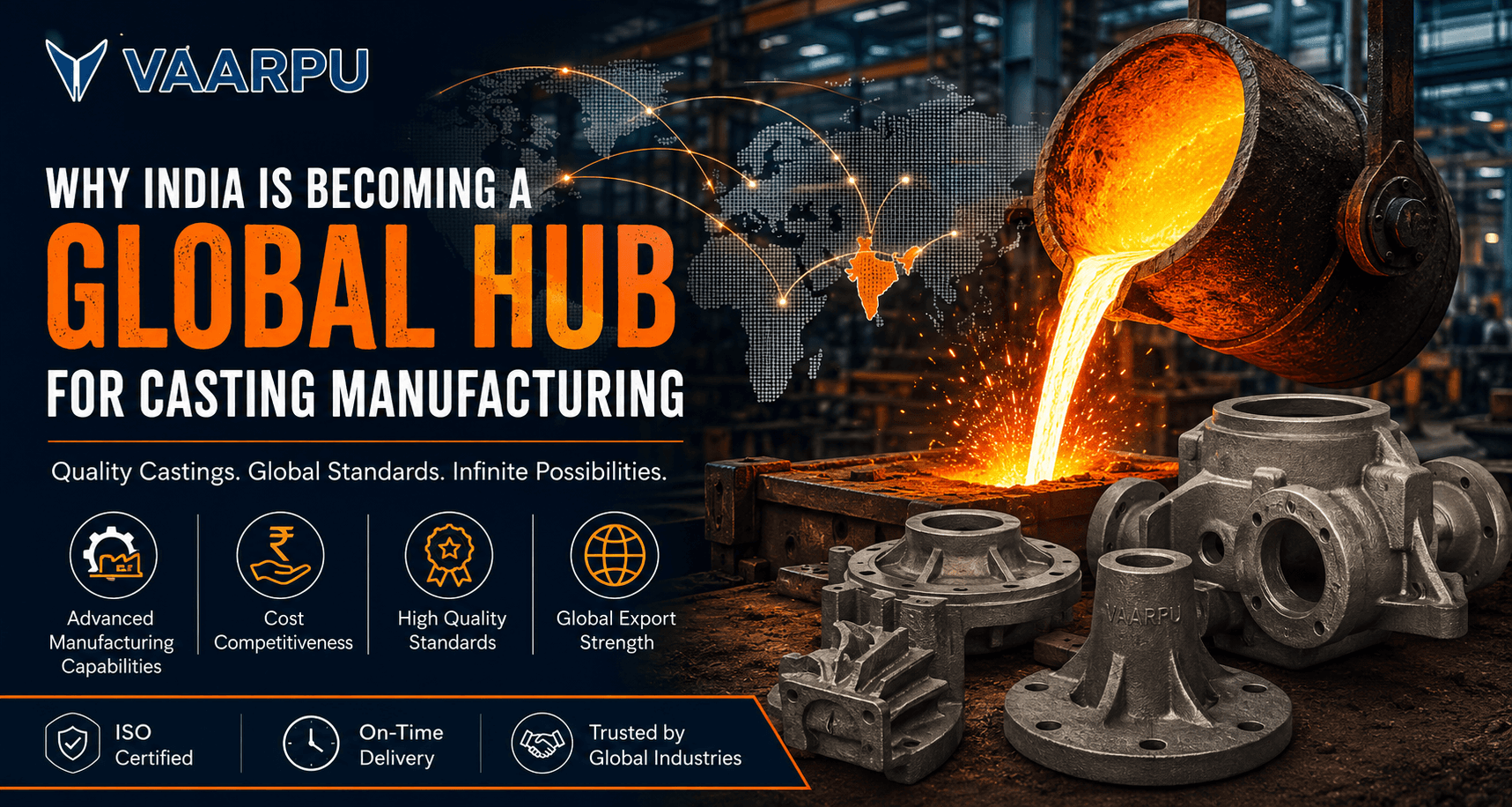
The global manufacturing landscape is undergoing a significant transformation, and India is emerging as one of the most attractive destinations for industrial production. Among the sectors experiencing remarkable growth, the casting industry stands out as a key contributor to India’s manufacturing success. From automotive components and heavy machinery parts to aerospace applications and infrastructure projects, Indian casting manufacturers are supplying high-quality products to customers worldwide.
As global companies seek reliable, cost-effective, and technologically advanced manufacturing partners, India has positioned itself as a preferred sourcing destination. The country’s combination of skilled labor, engineering expertise, modern foundries, competitive costs, and expanding industrial infrastructure has helped it gain recognition as a global casting manufacturing hub. Today, buyers from North America, Europe, the Middle East, and Asia increasingly turn to India for their casting requirements.
This article explores the major factors driving India’s growth in the casting industry and why it is becoming a leading global center for casting manufacturing.
Read more like How to Choose the Right Casting Supplier in India: Complete Buyer’s Guide
India’s Strong Foundation in Manufacturing
India has a long history of engineering and industrial manufacturing. Over the decades, the country has developed a robust industrial ecosystem that supports large-scale production across various sectors. The casting industry benefits from this well-established manufacturing base, which includes access to raw materials, engineering talent, machining facilities, testing laboratories, and logistics networks.
Industrial clusters located in Coimbatore, Rajkot, Kolhapur, Belgaum, Pune, Ahmedabad, Chennai, and other manufacturing centers have created specialized ecosystems that support foundries and metal casting operations. These clusters enable manufacturers to source materials efficiently, collaborate with suppliers, and deliver products to domestic and international customers more effectively.
The availability of supporting industries such as machining, fabrication, heat treatment, and surface finishing further strengthens India’s ability to provide complete manufacturing solutions under one roof.
Competitive Manufacturing Costs
One of the primary reasons international buyers choose Indian casting manufacturers is cost competitiveness. Compared to manufacturers in North America, Europe, and several other regions, Indian foundries can produce high-quality castings at significantly lower costs.
Lower labor expenses, efficient production systems, and access to local raw materials allow Indian suppliers to maintain competitive pricing without sacrificing quality. This cost advantage is particularly important for industries such as automotive, construction equipment, agriculture, and industrial machinery, where production costs directly impact profitability.
However, India’s competitive advantage is no longer based solely on low costs. Modern foundries are increasingly focusing on quality, automation, and value-added services, enabling them to compete globally based on performance as well as price.
Highly Skilled Workforce and Engineering Expertise
A major strength of India’s casting industry is its large pool of skilled engineers, metallurgists, technicians, and manufacturing professionals. The country produces thousands of engineering graduates every year, creating a steady pipeline of technical talent for the manufacturing sector.
Many Indian foundries employ experienced professionals who specialize in metallurgy, casting design, mold development, quality control, and production optimization. Their expertise allows manufacturers to produce complex components that meet demanding international specifications.
In addition to production capabilities, Indian casting manufacturers often provide engineering support services such as design optimization, prototyping, reverse engineering, and material selection. These value-added services help customers improve product performance while reducing manufacturing costs.
Advanced Manufacturing Technologies
The image of foundries as traditional manufacturing facilities is rapidly changing. Leading casting manufacturers in India are investing heavily in modern technologies to improve efficiency, consistency, and product quality.
Today’s advanced foundries utilize:
- Automated molding lines
- CNC machining centers
- Robotic handling systems
- CAD/CAM software
- Casting simulation tools
- 3D modeling technologies
- Digital quality management systems
- Real-time production monitoring
Casting simulation software enables manufacturers to identify potential defects before production begins, reducing waste and improving product quality. Automation improves consistency and productivity, while digital monitoring systems help optimize manufacturing processes.
These technological advancements allow Indian foundries to meet the increasingly demanding requirements of global industries.
Growing Export Capabilities
India’s casting industry has established a strong presence in international markets. Indian manufacturers export castings to countries across Europe, North America, Asia-Pacific, Africa, and the Middle East.
Several factors contribute to India’s export success:
- Compliance with international quality standards
- Competitive pricing
- Strong engineering capabilities
- Reliable logistics infrastructure
- Experience serving multinational corporations
Many Indian foundries hold certifications such as ISO 9001, IATF 16949, ISO 14001, and other industry-specific accreditations. These certifications help build confidence among global buyers and demonstrate commitment to quality and process control.
As international demand for cast components continues to grow, Indian manufacturers are expanding their export operations and strengthening relationships with overseas customers.
Government Support for Manufacturing Growth
Government initiatives have played an important role in accelerating the growth of India’s manufacturing sector. Programs such as Make in India, Production Linked Incentive (PLI) schemes, and infrastructure development projects have encouraged investment in manufacturing capabilities.
Improved highways, ports, industrial corridors, and logistics networks have enhanced supply chain efficiency and reduced transportation costs. These developments make it easier for casting manufacturers to serve customers both within India and around the world.
The government’s focus on attracting foreign investment and promoting industrial growth has also encouraged modernization across the casting sector.
Strong Demand from Key Industries
India’s casting industry benefits from demand generated by a wide range of industries. The automotive sector remains one of the largest consumers of cast components, using castings in engines, transmissions, braking systems, suspension components, and structural parts.
Other industries driving demand include:
- Railways
- Aerospace
- Defense
- Agriculture
- Mining
- Construction equipment
- Renewable energy
- Oil and gas
- Heavy engineering
The diversification of end-user industries helps create stability and long-term growth opportunities for casting manufacturers. As infrastructure projects expand and industrial production increases globally, demand for cast components is expected to remain strong.
Supply Chain Diversification Opportunities
Recent global events have highlighted the risks associated with relying on a single manufacturing region. Many multinational companies are now pursuing supply chain diversification strategies to improve resilience and reduce operational risks.
India has emerged as a preferred alternative sourcing destination because of its large manufacturing capacity, stable business environment, and growing industrial infrastructure. Global buyers increasingly view India as a strategic partner capable of supporting long-term sourcing requirements.
This shift presents significant opportunities for Indian casting manufacturers to expand their market share and establish stronger relationships with international customers.
Focus on Quality and Sustainability
Quality has become a critical factor in global manufacturing. Indian foundries are investing heavily in quality control systems, testing laboratories, and process improvements to meet international expectations.
Common quality assurance practices include:
- Spectrometer testing
- Coordinate Measuring Machine (CMM) inspections
- Ultrasonic testing
- Radiographic inspections
- Metallurgical analysis
- Mechanical property testing
At the same time, sustainability is becoming increasingly important. Many casting manufacturers are implementing environmentally responsible practices such as energy-efficient furnaces, waste reduction programs, sand reclamation systems, and renewable energy initiatives.
These efforts help manufacturers meet customer expectations while reducing environmental impact.
Major Casting Manufacturing Hubs in India
Several regions have established themselves as key centers for casting production:
| Region | Specialization |
| Coimbatore | Pump components, industrial castings |
| Rajkot | Automotive and engineering castings |
| Kolhapur | Automotive and heavy engineering |
| Belgaum | Precision and industrial castings |
| Pune | Automotive and aerospace components |
| Chennai | Automotive and export-oriented manufacturing |
| Ahmedabad | General engineering castings |
These manufacturing hubs continue to attract investments and contribute significantly to India’s global competitiveness.
The Future of India’s Casting Industry
The future of India’s casting industry appears highly promising. Continued investments in automation, digital manufacturing, sustainability, and workforce development are expected to enhance competitiveness further.
Emerging sectors such as electric vehicles, renewable energy, aerospace, and advanced industrial machinery will create new opportunities for casting manufacturers. As technology adoption accelerates and quality standards continue to improve, India is well-positioned to become an even more influential player in the global casting market.
Industry experts predict that India’s share of global casting production will continue to increase as international buyers seek reliable manufacturing partners capable of delivering high-quality products at competitive prices.
Conclusion
India’s rise as a global hub for casting manufacturing is the result of several interconnected factors, including competitive production costs, engineering expertise, advanced manufacturing technologies, strong export capabilities, government support, and a rapidly evolving industrial ecosystem. The country’s foundries are no longer competing solely on price; they are increasingly recognized for their quality, innovation, and ability to meet complex manufacturing requirements.
As global industries continue to diversify their supply chains and seek dependable sourcing partners, India is positioned to play an increasingly important role in the future of casting manufacturing. For businesses seeking high-quality cast components, India’s manufacturing sector offers a compelling combination of value, expertise, and long-term reliability.
Partner with an ISO-Certified Casting Manufacturer in India
As India continues to strengthen its position as a global casting manufacturing hub, businesses worldwide are seeking trusted suppliers capable of delivering quality, reliability, and cost-effective production solutions. Finding the right manufacturing partner is essential for maintaining competitive advantages and ensuring supply chain stability.
At Vaarpu, we are proud to be an ISO-certified casting manufacturer in India, serving customers across diverse industries with precision-engineered casting solutions. Our focus on quality assurance, advanced manufacturing processes, and customer-centric service enables us to meet the evolving needs of global buyers.
From prototype development to large-scale production, Vaarpu delivers casting solutions designed to support your business growth while maintaining the highest standards of performance and consistency.
Ready to source castings from one of India’s trusted manufacturing partners? Contact Vaarpu today and explore our comprehensive range of casting solutions.
Frequently Asked Questions
-
Why is India considered a leading casting manufacturing destination?
India offers competitive costs, skilled labor, advanced manufacturing facilities, and strong export capabilities, making it an attractive destination for casting production.
-
Which industries use castings manufactured in India?
Automotive, aerospace, railways, defense, mining, agriculture, construction equipment, renewable energy, and heavy engineering industries commonly source castings from India.
-
What types of castings are produced in India?
Indian manufacturers produce cast iron, ductile iron, steel, stainless steel, aluminum, alloy steel, and precision investment castings.
-
Which cities are major casting manufacturing hubs in India?
Coimbatore, Rajkot, Kolhapur, Belgaum, Pune, Chennai, and Ahmedabad are among India’s leading casting manufacturing centers.
-
What is the future outlook for India’s casting industry?
The industry is expected to grow steadily due to increasing exports, technological advancements, infrastructure development, and rising demand from emerging sectors such as electric vehicles and renewable energy.